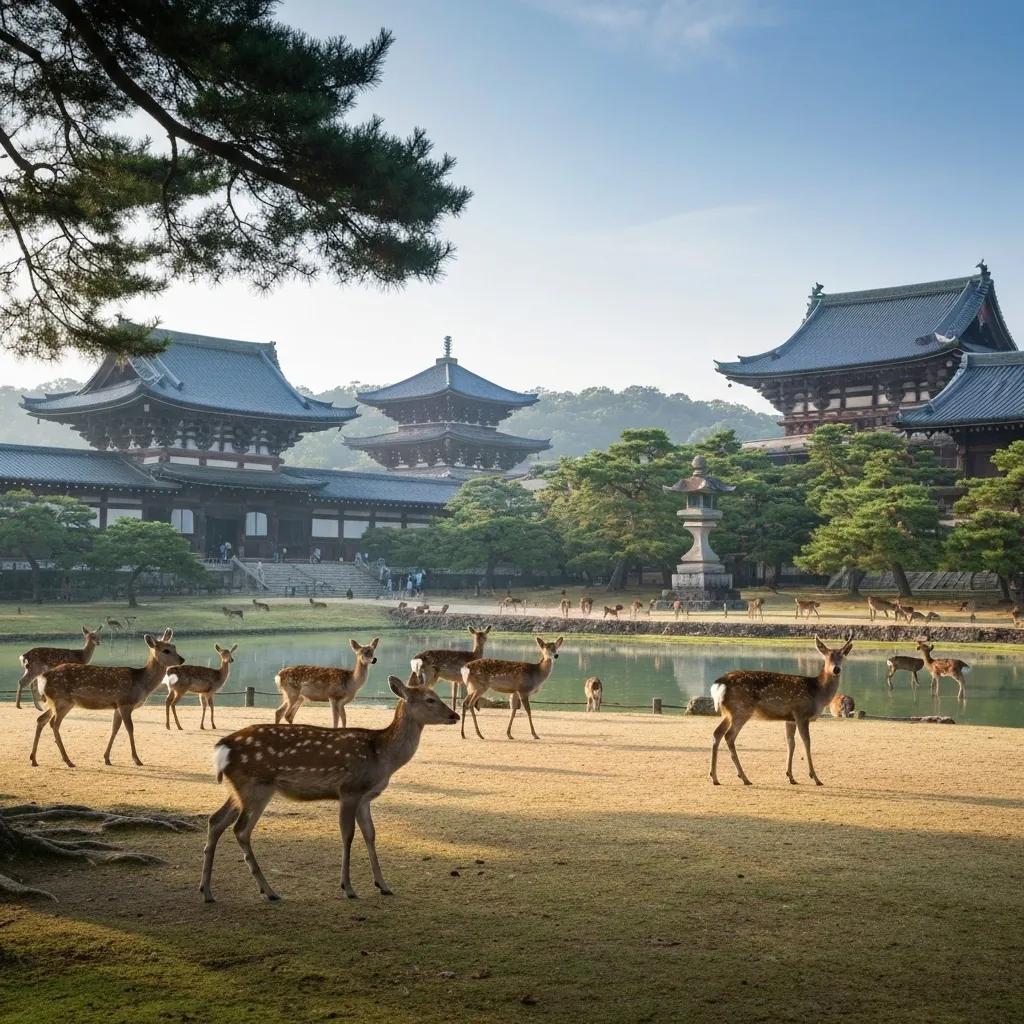
Todai-ji Temple
5 min walk from Nara Park
This temple houses a large bronze Buddha statue and complements the park visit by providing an immediate immersion into Nara's historical architecture. Location: Nara Park, Nara City, Nara Prefecture, Japan

The question of whether Nara sits closer to Osaka or Kyoto shapes how thousands of visitors structure their Kansai itineraries each year. The answer is not as straightforward as a map might suggest—proximity by rail, travel time, and geographic distance all tell slightly different stories. This guide lays out the figures you need to make an informed routing decision.
Quick answer
Nara is geographically closer to Kyoto by straight-line distance—approximately 35 kilometers compared to roughly 40 kilometers from central Osaka. However, rail travel time from Osaka to Nara is often faster due to direct express services on the Kintetsu and JR lines, taking 35 to 50 minutes, while the trip from Kyoto typically requires 45 to 75 minutes depending on the route and transfers.
The Kansai region's three anchor cities form a compact triangle, with Nara occupying the southeastern corner. By air distance, Kyoto lies closer—around 35 kilometers from Nara compared to Osaka's 40 kilometers. Yet distance alone does not dictate convenience. Rail infrastructure, service frequency, and transfer requirements reshape what proximity means in practice. Osaka maintains two primary rail corridors into Nara: the Kintetsu Nara Line, which runs express trains from Osaka-Namba to Kintetsu-Nara Station in roughly 35 minutes, and the JR Yamatoji Line, connecting Osaka's Tennoji district to JR Nara Station in approximately 50 minutes. Both routes offer direct service without transfers, high frequency during daytime hours, and station terminals within walking distance of Nara Park. The Kintetsu route deposits visitors closest to Kofuku-ji Temple and the main deer grounds, while the JR station sits slightly west. Kyoto's connection depends on whether you prioritize speed or cost. The JR Nara Line from Kyoto Station reaches Nara in 45 minutes via the Miyakoji Rapid service, a direct train that runs hourly. Local JR trains on the same line take 70 to 75 minutes with multiple stops. The Kintetsu Kyoto Line offers an alternative from Kyoto Station to Kintetsu-Nara, typically requiring a transfer at Yamato-Saidaiji and taking 50 to 65 minutes total. Neither Kyoto route matches Osaka's combination of speed and simplicity, though the gap narrows if your Kyoto starting point is already near Kyoto Station. The practical takeaway: if basing yourself in Osaka, Nara functions as a straightforward 35-minute express ride. From Kyoto, plan for closer to an hour. Geographic proximity favors Kyoto; operational convenience favors Osaka. The answer to whether Nara is closer to Osaka or Kyoto ultimately depends on whether you measure in kilometers or in minutes spent on a train.
“Geographic proximity favors Kyoto; operational convenience favors Osaka.”
Nara is accessible via direct rail lines from major transit hubs in both Osaka and Kyoto. Travelers typically utilize the Kintetsu or JR lines to reach Nara Station or Kintetsu-Nara Station.
Kintetsu Nara Line from Osaka-Namba Station to Kintetsu-Nara Station
JR Yamatoji Line from JR Osaka Station to JR Nara Station
Kintetsu Kyoto Line from Kyoto Station to Kintetsu-Nara Station
JR Nara Line from Kyoto Station to JR Nara Station
Nara Park, located at Nara City, Nara Prefecture, Japan, is best visited between 07:00–09:00. Arriving during this window avoids peak daytime crowds and offers a calmer atmosphere with the deer.
The best arrival window is 07:00–09:00 to avoid peak daytime crowds and experience a calmer atmosphere with the deer. Arriving early provides a superior visit regardless of whether your origin is Osaka or Kyoto.
—
Reduced visitor volume creates the most peaceful environment.
Mild, 12°C to 23°C
Cherry blossoms attract significant domestic and international interest.
Humid, 24°C to 33°C
Frequent rain and high temperatures characterize this season.
Cool, 12°C to 20°C
Changing foliage draws large crowds throughout the park.
Verdict: For the quietest experience, visit on a weekday between 07:00 and 09:00 during April or October.
Nara serves as a functional midpoint between Osaka and Kyoto, allowing travelers to integrate historical landmarks into a broader regional itinerary. Pairing these locations facilitates a logical flow through the Kansai region's cultural landscape.
5 min walk from Nara Park
This temple houses a large bronze Buddha statue and complements the park visit by providing an immediate immersion into Nara's historical architecture. Location: Nara Park, Nara City, Nara Prefecture, Japan
15 min walk from Nara Park
Located within the forest adjacent to the park, this shrine offers a serene atmosphere that balances the openness of the deer park with shaded, lantern-lined paths. Location: Nara Park, Nara City, Nara Prefecture, Japan
10 min walk from Nara Park
This museum holds a significant collection of Buddhist art and archeological artifacts, serving as a quiet indoor option to contrast with outdoor sightseeing. Location: Nara Park, Nara City, Nara Prefecture, Japan
Everything you need to know about is nara closer to osaka or kyoto
Geographically, Nara sits at a similar distance from both cities, though travel times vary based on your departure point. Determining if Nara is closer to Osaka or Kyoto depends largely on which train line you utilize for your journey. Many travelers find that the transit networks effectively bridge the gap between these historic regions. Planning your route carefully helps you decide if Nara is closer to Osaka or Kyoto for your specific itinerary.
Travel between Kyoto and Nara typically takes between 35 and 50 minutes depending on whether you take the JR line or Kintetsu Railway. Direct connections make it easy to incorporate Nara into your broader Kyoto and Nara day tour plans. This efficiency ensures that you spend more time exploring local landmarks rather than commuting. While researching if Nara is closer to Osaka or Kyoto, you will find both options offer rapid regional connectivity.
Yes, Nara is a highly accessible destination for a day trip from Osaka, with direct train services taking roughly 40 to 50 minutes. The proximity allows visitors to experience the Great Buddha and local shrines without needing to change hotels. When considering if Nara is closer to Osaka or Kyoto, keep in mind that both cities serve as excellent bases. Your choice will likely depend on your overall accommodation strategy in the Kansai region.
The cultural significance of the region is preserved through sites like Nara Park, which remains open to the public daily. While historical temples charge individual fees, walking through the park grounds is free. Visitors often ask if Nara is closer to Osaka or Kyoto when mapping out visits to sacred heritage sites. Consistent transport links ensure that this cultural exploration remains a central part of any Kansai visit.
Entry to Nara Park is 0 JPY, providing free access to the expansive grounds and the famous deer population. Individual temples and museums located within or near the park have their own separate admission fees. As you evaluate if Nara is closer to Osaka or Kyoto, remember that these cost-effective public spaces are a highlight of the city. We recommend checking individual site policies for the most current pricing details.
The best arrival window is 07:00–09:00 to avoid peak daytime crowds and enjoy a calmer atmosphere with the deer. Early visits provide a better experience before the mid-day arrival of larger tour groups. Planning your transport to hit this window is recommended regardless of whether you are coming from Kyoto or Osaka. This time frame allows for a more personal encounter with the park's resident wildlife.
Local train lines like the Kintetsu Railway and JR West provide the most reliable access between these cities. Most visitors prefer the Kintetsu line as it often drops you closer to the primary attractions in Nara. Whether you find that Nara is closer to Osaka or Kyoto, these rail systems are designed for high-frequency travel. Check local schedules on the day of your departure to ensure the smoothest connection.